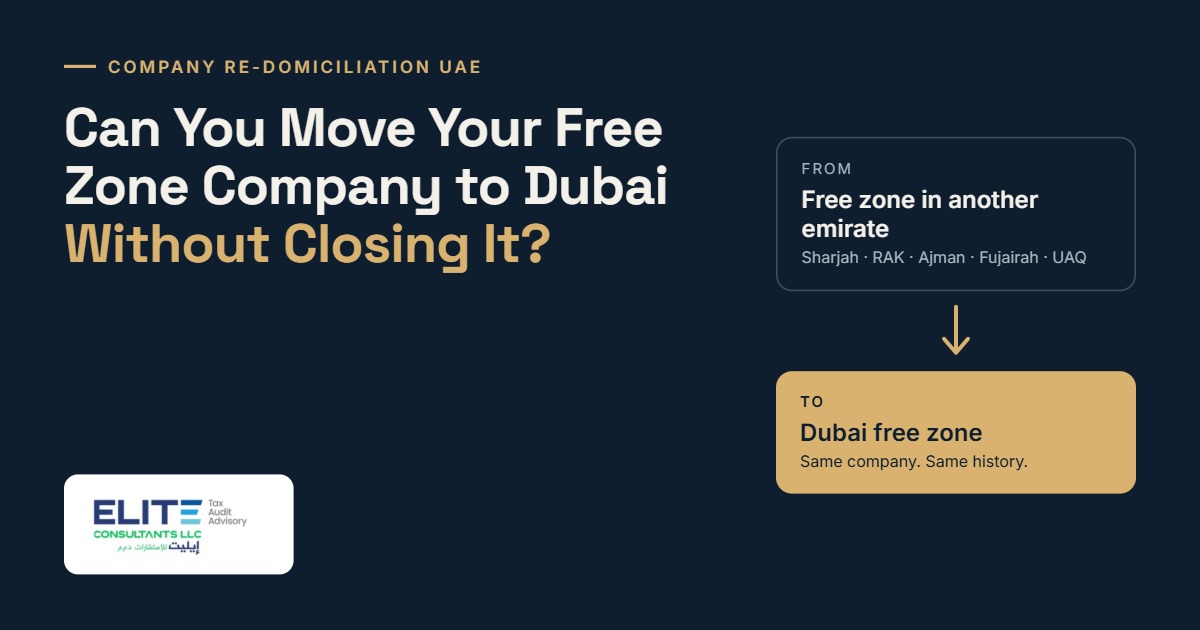
Can you move your free zone company to Dubai without closing it?
A lot of businesses in the UAE start in a free zone in Sharjah, Ras Al Khaimah, Ajman, Fujairah or Umm Al Quwain. At the start it makes sense. The setup is quick and the costs are manageable. Then a few years later the business grows, the clients are in Dubai, the team is working from Dubai, and the owner starts asking the same question: can we move the company to Dubai?
Most people think there is only one way to do it. Cancel the old company, open a new one in Dubai, and start from zero. We hear this almost every week.
The good news is that it is not the only option. A free zone company can be transferred to a Dubai free zone through a process called re-domiciliation. In this article we explain what it is, how it works, what it protects, and where it can get complicated.
Why companies outgrow their first free zone
Nobody makes a bad decision by starting small. Free zones in the northern emirates are popular because they are fast and affordable, and for a new business that is exactly what matters. The company gets a license, a visa quota and a legal base without a large upfront commitment.
The picture changes as the business matures. The main clients and partners are based in Dubai. Meetings happen in Dubai. Banks, suppliers and investors often expect a Dubai address. New hires prefer to be in Dubai, and the owner is spending more and more time there anyway. The license is still valid, but the registration no longer reflects where the business actually operates.
Some owners also want access to a different business environment, such as a specific Dubai free zone with a sector focus, better infrastructure or a stronger reputation in their industry. Whatever the reason, the question is the same: how do we move without breaking what we have built?
Which UAE free zone is right for your business?
Before deciding where to move, compare how different free zones fit your activity, license type and growth plans.
Read the free zone comparisonWhat is company re-domiciliation in the UAE?
Re-domiciliation simply means moving your existing company from one free zone to another. The company is not closed and reopened. It continues to exist as the same entity, only now it is registered in the new free zone.
The easiest way to understand it is to separate the company from its address. The company is the legal entity, with its history, its shareholders and its commercial relationships. The free zone is where it is registered and licensed. In a re-domiciliation, the entity stays and the registration moves.
| Route | What happens to the company |
|---|---|
| Re-domiciliation | The same entity continues. Its registration moves from one free zone to another. |
| License amendment | The company stays in the same free zone and only its license details change. |
| Cancel and reincorporate | The old company is closed and a new company is incorporated in Dubai. |
| Move to mainland | A separate route with its own rules, covered by mainland company setup, not by this article. |
Here we are talking only about free zone to free zone. Recently we received an inquiry from a client whose company has been registered for 14 years in a free zone outside Dubai. They wanted to shift the license to Dubai. Instead of giving the usual answer, we checked directly with a Dubai free zone authority. They confirmed that companies from other free zones can re-domicile to them.
Why transfer instead of closing and opening a new company
For a new company, closing and reopening may not matter much. For a company that has been operating for 10 or 15 years, it does. The incorporation history and track record of the company are worth keeping.
Cancellation and a fresh business setup in Dubai also take time, and the business still has to keep running in the middle of all that. A transfer avoids starting everything again. Here is what a transfer helps you protect:
Company age
A company with a long operating history looks different to banks, landlords, suppliers and tenders than one incorporated last month. A re-domicile lets you keep the answer to "how long have you been in business?"
Continuity with clients and partners
Contracts, licenses and relationships are tied to the company. When it is closed, each has to be reviewed, renewed, novated or signed again, which costs time and legal fees and risks losing a client.
Less duplication
A new company means a new trade name, new documents, new applications and a new set of approvals. For a company that already runs smoothly, that adds friction and little value.
Banking and compliance history
A cancellation usually means closing accounts and starting banking from scratch. A transfer still requires a bank update, but it is a very different conversation when the entity stays the same.
Fewer gaps
Cancelling one company and opening another leaves a gap, even if short. With a planned re-domicile, the steps can be sequenced so the business keeps trading while the registration moves.
How the process works
In general terms, your current free zone issues an NOC allowing the company to move. You then apply to the Dubai free zone, and once the new license is issued, the company is de-registered from the previous free zone.
The Dubai free zone has its own requirements and formats, and the documents need to be prepared properly. This is where most of the time goes, so it helps to plan it from the beginning. Every free zone runs its own procedure, but a typical re-domicile follows this path:
Check eligibility
Confirm that the Dubai free zone accepts transfers from your current free zone, and that your activity is allowed under its license categories. Most people skip this step, and a direct inquiry saves weeks of wasted effort.
Clean up the current registration
Your current free zone will want the company in good standing: license valid, fees paid, no outstanding fines or pending obligations. An NOC is hard to obtain while something is unresolved.
Obtain the NOC
Request a No Objection Certificate from the current free zone confirming it does not object to the move. Some free zones also ask for approvals or confirmation about visa holders and office arrangements.
Apply to the Dubai free zone
Submit the application with the NOC and company documents. The new free zone reviews the shareholder structure, activity and records under its own rules, and may ask for corrections or extra documents.
Receive the new license
Once approved and fees are paid, the Dubai free zone issues the new license and registration. The premises arrangement, such as a flexi desk or an office, is usually part of this stage.
De-register and update
The company is de-registered from the previous free zone. Then comes the practical work of updating the bank, tax registrations, contracts, letterheads and everything else that carries the old details.
Documents you should prepare early
The paperwork is where most delays happen, usually because a document is in the wrong format or is missing something small. While the exact list depends on the free zone, you should expect to be asked for items such as:
- The current trade license and registration certificate
- The memorandum or articles of association, and any amendments
- Shareholder and director passports, with visa or Emirates ID copies
- A shareholder resolution approving the transfer
- The NOC from the current free zone
- Proof of the current lease or premises
- Depending on the company, audited or management accounts, or a bank reference
The Dubai free zone may require documents in its own template, and some need to be signed, stamped or attested in a specific way. Preparing them correctly the first time is the single biggest thing you can do to keep the timeline under control.
What changes after the move
A re-domicile keeps the company, but it does not leave everything untouched. Think of it as the same business in a new home. Some things move with you, and some have to be redone or updated.
| Area | What to plan for |
|---|---|
| Visas and Emirates IDs | Employee and shareholder residence visas are tied to the old registration and must be transferred or reissued under the new license, in line with the Dubai free zone's process. Plan this with your PRO services team so nobody is left without valid status mid-move. |
| Bank accounts | Your bank needs to know about the new license and address, and may run a fresh review. Tell your relationship manager early and ask what they need, so the account is not restricted while documents are pending. Our bank account support can help if the review becomes complicated. |
| Tax registrations | Update your details with the relevant authorities, including corporate tax and VAT registrations where applicable. Review your tax position before the move, not after, because a change in free zone can affect how your income is treated. |
| Contracts and branding | Contracts, invoices, website, email signatures, marketing material and platform listings all carry your license details. Update them once the new license is issued, and tell key clients in advance so nothing looks unexpected. |
| Ongoing costs and rules | The new free zone has its own fee structure, renewal cycle and compliance requirements. Understand these before you commit, and see our guide to the free zone compliance calendar so the cost of the new setup is not a surprise. |
How to pay zero corporate tax in the UAE
A change of free zone can affect how your income is treated, so review the qualifying conditions before you move.
Read the corporate tax guideCommon obstacles and how to avoid them
Most re-domiciliations that stall do so for a handful of repeat reasons.
Unresolved obligations
Outstanding dues, expired licenses or unresolved issues with the current free zone can block the NOC. Settle them before you apply.
Activity mismatch
Not every activity is available in every free zone. If yours is not on the Dubai free zone's list, you may need to adjust it, and that has to be planned.
Complex shareholder structure
Corporate shareholders, multiple owners or layered structures need more documentation, and authorities may ask for extra records to verify ownership.
Gaps in records
A company that has not kept up with renewals, annual filings or accounts can face extra questions. Get the records in order first.
Wrong formats
Documents prepared in the wrong format are returned, and each round of corrections adds days. Prepare against the Dubai free zone's requirements, not the old one's.
Late planning
Starting the visa, bank and tax updates only after the license is issued leaves a gap. Work these in parallel where the process allows it.
The 2026 UAE free zone compliance and cost matrix
See why the license is only part of the story, and what compliance and cost items to budget for in any free zone.
Read the compliance and cost matrixQuestions to ask before you decide
Before choosing between cancelling and re-domiciling, run through a few simple questions:
- How long has the company been operating, and how valuable is that history to your clients and banks?
- Are there contracts or licenses that would be difficult to replace?
- Does the Dubai free zone you have in mind accept your activity and your shareholder structure?
- How many visa holders will be affected?
- What does the tax position look like before and after the move?
If the company is young, has few contracts and no real history to protect, a fresh setup may be the simpler route, and our guide to Dubai free zone company setup covers that path. If it is established, a transfer deserves serious attention. The right answer depends on the facts, and it is much cheaper to find that out before cancelling than after.
Is this right for your company?
If your company is in a free zone in another emirate and you are planning to move your business to Dubai, look at re-domiciliation before you decide to cancel. It is not well known, but it can save you from starting over.
Every case is a little different, depending on the activity and the shareholder structure. If you want to know whether your company can be transferred, contact us at salman@eliteconsultingsllc.com and we will check it for you.
Mian Salman | Business Setup Advisor
Find out if your company can be transferred, before you cancel
Share your current free zone, activity and shareholder structure, and we will check directly with the Dubai free zone whether a re-domiciliation is possible.
Check my transfer optionsFrequently asked questions
Can I move my free zone company to Dubai without closing it?
Is re-domiciliation the same as moving a free zone company to the mainland?
What happens to my visas and bank account after the move?
When is cancelling and opening a new company the better option?